
The Unreliable – Using smart speaker as smart home’s portal
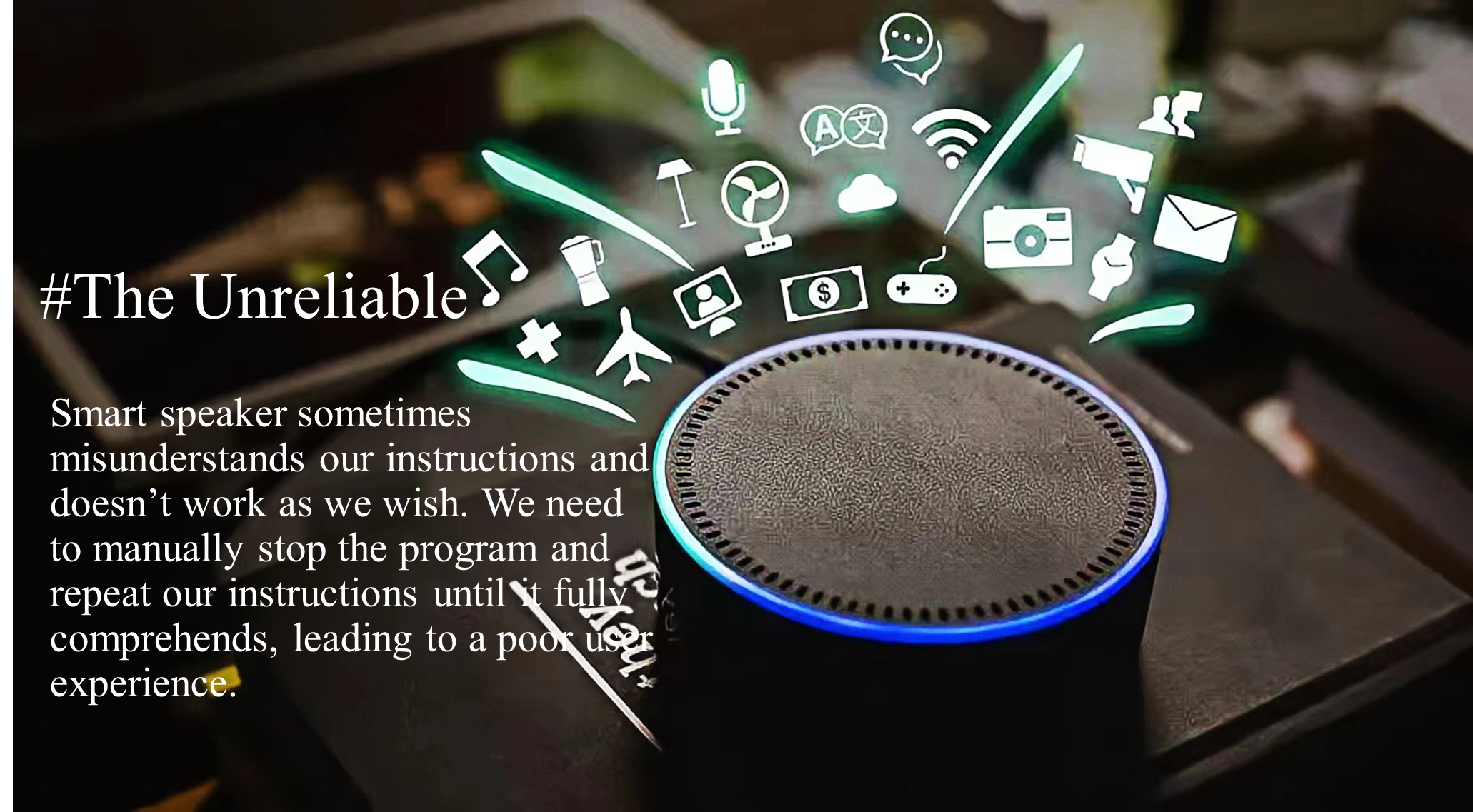
Poster in Phase II
In Essay I, I’ve mentioned that applying smart speaker as the central controller of the smart furniture may mass up everything when speaker misunderstands humans’ commands and send out wrong instructions to other furniture. For users, sometime it’s hard to withdraw these misunderstood commands, which might cause irreversible damage and even mass up everything. However, as I go deeper into this product, I have a better understand of this product, which leads to a change of the topic. That is, the main factor causing these problems is not the design itself but the back-up techniques. However, we can still try to avoid these problem by adding some ingenious design.
For the topic of my essay, I change the key word from “the Bad” to “the Unreliable” for a more accurate explanation of its defect. From my own perspective, the troublesome issues arise while using smart speakers as smart home’s portal are not caused by design of the product but the back- up techniques like NLP and speech recognition. However, since we are now witnessing outbreaks, like ChatGPT, bursting out from these academic areas, I think these problems will eventually be sorted out and this product will become mature using as a smart portal. And what I need to do is to focus on the shortcomings the product reveals in this stage, and try to find a better solution to reduce these inevitable impacts.
To refine this product, we need a good perspective to look into the problems. Among all the tools taught in CSIT6000N, I think the usability heuristics analysis will be of great help, as almost all the problems can be categorized into two parts, Error Prevention and Error Recovery. We can figure out the solutions from these two angles.
For error prevention, since it’s hard to prevent instructions misunderstanding for the speaker, we can let the speaker report the command it received and wait for the confirmation from the user. Only when the user gives a positive answer will the speaker execute this command and give out the further instructions. This additional process can provide an accurate execution of humans’ command but will bring unnecessary cost on efficiency. If subtle faults is acceptable, we can let the speaker firstly analyze the command. When the command includes some sensitive operations, we can let the speaker pauses the mission, repeat what it heard and wait for further confirmations.
For the error recovery, we can let the speaker maintain a cache to record the command history and offer some special keywords that is distinguishable enough to the speaker, like “Stop”, to let users to stop current execution. What’s more, since the speaker should work as the center controller of all the smart furniture, we should have a special design on wrong command withdrawing. When the user suspends the execution of some commands while some further instructions have been distributed, the speaker should send out withdraw instructions according to previous execution, which can force the target smart furniture back to the previous state all let the whole smart home recovery from the wrong execution. However, adaptation issues might hinder the implementation of this solution as there are countless brands and types of smart furniture to adapt. It seems impossible for one single smart speaker manufacturer and maybe the whole industry should promote a well-designed communication protocol and force all the smart furniture manufacturers to follow this standard.